
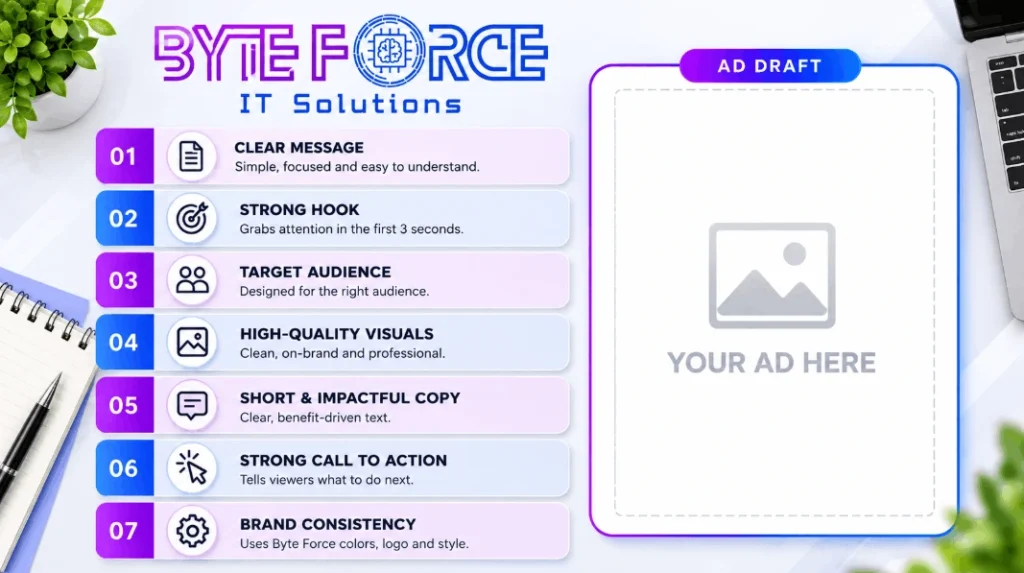
Run seven checks before you write any ad copy. Set one goal. Pick one reader. Collect their words. List your offer and proof. Study your rivals. Choose one angle. Plan the click and the test. Do these in order, and your copy gets much easier to write.
Planning matters more than most teams think. In 2017, Nielsen studied nearly 500 campaigns and found that creative drove 47% of the sales lift from ads, the biggest share of any factor. Google shares a case where the airline Swoop added its best keywords to its search ads and lifted conversions by 61%. Old-school copy shows the same thing. Bob Stone built a famous Kiplinger letter on a 7-step outline, and it beat every rival test for more than 35 years.
Why Most Ad Copy Fails Before the First Word
Most weak ads start with a blank page and a rush. The writer then guesses the rest. Here is what usually goes wrong:
- The goal stays vague, so the ad tries to do too much.
- The writer guesses what the reader wants.
- The offer has no proof behind it.
- The ad repeats what every rival already says.
- The click lands on a page that does not match the ad.
Our framework fixes each one. We run it on every campaign at Byte Force IT Solutions before we write a single headline.
The 7 Steps to Run Before You Write Ad Copy
Step 1: Set One Clear Goal
Pick one action you want the reader to take. One ad gets one goal.
- Book a call
- Fill out a form
- Buy a product
- Download a guide
Write the goal as a full sentence with a number. For example: “This ad must bring 20 form fills at a cost we can afford.” Now you can judge the copy by results, not by taste.
Step 2: Write a One-Line Audience Brief
Answer three questions in one sentence. Who is the reader? What do they want? What holds them back?
Here is a sample: “Clinic owners who want more patient calls but waste money on clicks that never call.”
Keep this line beside you while you write. If a sentence does not speak to that person, cut it.
Step 3: Collect Your Customer’s Own Words
Your customers already describe their problem in plain words. Copy those words.
Look in these places:
- Google reviews and testimonials
- Support emails and chat logs
- Sales call notes
- Reddit threads and Facebook groups
- Questions people type into search
Save the exact phrases. An ad that sounds like the reader feels real, so the reader stops to read it.
Step 4: List Your Offer, Proof, and Limits
Write down what you sell and why it helps. Then gather proof. Proof turns a claim into a fact.
- Numbers, such as leads gained or hours saved
- Reviews and short client quotes
- Awards, certificates, and years of work
- Simple before and after results
Next, list the top three doubts a buyer may have, such as price or trust. Answer each doubt in your copy. Also note any claims you cannot make, so your ad stays honest and safe.
Need help pulling this together? Our team can plan your paid ads and digital media marketing support from the first goal to the final report.
Step 5: Check What Your Rivals Say
Search your main keywords. Read the top ads and landing pages. This takes about 30 minutes.
Write down three things:
- The claims every rival repeats
- The offers they push
- The gap nobody fills
Fill that gap. If every rival says “fast,” you can say “clear” or “proven” instead.
Step 6: Pick One Angle and One Framework
An angle is the lens you use to tell your message. Pick one.
- Pain: Start with the problem and offer relief.
- Proof: Lead with results and real numbers.
- Price: Lead with value or a clear deal.
- Speed: Show how fast the reader gets the result.
Then choose a simple structure to hold the angle:
- PAS: Problem, Agitate, Solution. It works well for new writers because it has only three parts.
- BAB: Before, After, Bridge. It shows the change your service brings.
- AIDA: Attention, Interest, Desire, Action. It suits longer ads and emails.
Do not mix all three. One angle with one structure keeps the ad clean.
Step 7: Plan the Click, the Page, and the Test
Finish the plan before you write. Decide three things.
The call to action. Google advises specific calls to action over vague ones. Ask the reader to request a quote or call now, not just “learn more.”
The landing page. The page must match the ad. If the ad promises a price, the page must show it. Good on-page basics also help, so review our SEO services that support your landing pages if your pages need work.
The test plan. Write at least two ad versions and change one thing at a time. Google reports that advertisers who lift their Ad Strength from Poor to Excellent see 15% more clicks and conversions on average, based on its own data from August 2025.
Your Quick Pre-Writing Checklist
Print this list and tick each box before you open a blank page:
- One goal, written with a number
- One audience brief
- A list of your customer’s own words
- Your offer, proof, and doubts
- Three rival claims and one gap
- One angle and one framework
- One CTA, one matching page, and two test versions
Stuck on any box? Ask our team for an ad copy plan and we will help you fill it in.
Common Mistakes to Avoid
- Skipping research. Guesses cost more than research.
- Picking two goals. A split message gets a split result.
- Talking about features only. Readers care about what they gain.
- Using vague CTAs. “Click here” gives no reason to act.
- Making claims you cannot prove. Trust drops fast when proof is missing.
- Testing five things at once. You will not know what worked.
Why Choose Byte Force IT Solutions
Byte Force IT Solutions is a digital marketing and SEO company. We help businesses show up in search, earn trust, and turn clicks into leads. Our team runs this same 7-step framework before we write ads for any client, so every word has a job to do.
Our digital marketing work covers paid ads, media campaigns, and content that fits each step of your buyer’s path. On the SEO side, we plan keywords, build pages that rank, and shape them to convert. Both sides of our team work together, so your ads and your search pages tell one clear story.
We keep our process simple. We start with your goal and your reader. Then we write, test, and report in plain language. You always know what we changed and why.
Ready to work with a team that plans before it writes? Talk to us about a custom ad plan and let us build your next campaign on a strong base.
Conclusion
Good ad copy starts long before the first headline. Set one goal, know one reader, gather proof, and study your rivals. Pick one angle, plan the click, and test with care. Run these seven steps each time, and your ads will stay clear, honest, and focused on results.