
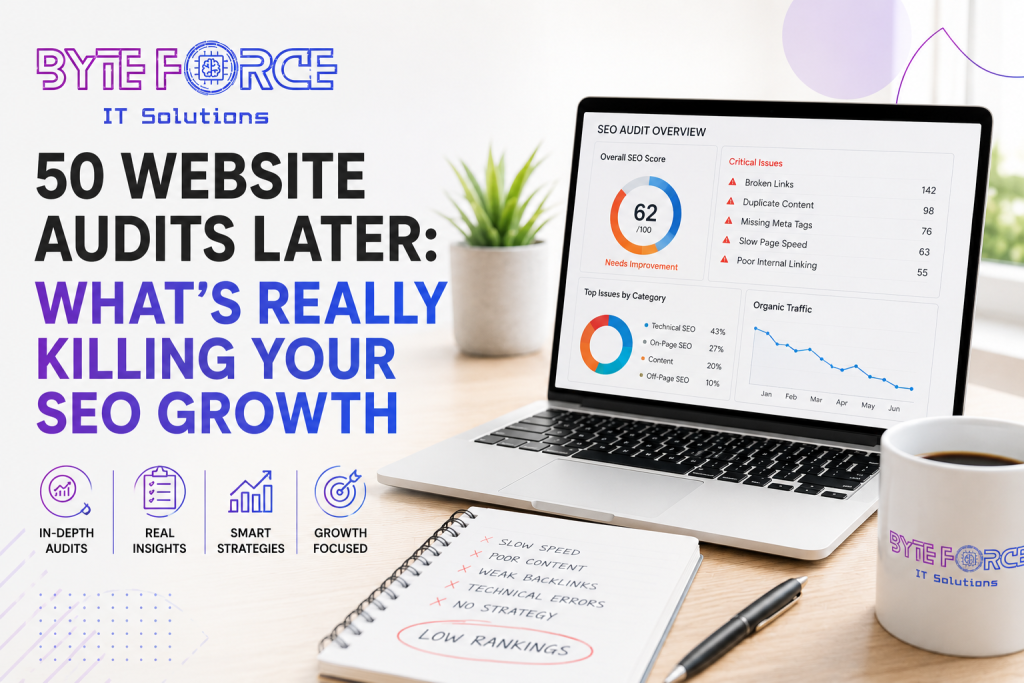
Slow pages, broken links, and missing keywords were the top three problems we found across 50 real website audits, and together they were quietly draining traffic and sales for months before anyone noticed.
That number is not made up. According to Google Search Central’s latest guidance, updated in December 2025, Core Web Vitals are used by Google’s ranking systems, and site owners are encouraged to achieve good scores to support Search performance and deliver a better user experience. Slow, clunky websites are not just annoying, they can cost real businesses real money every single day.
We see this pattern over and over. A business owner builds a nice looking website, waits for customers to show up, and nothing happens. So they call us. Before we start any SEO work, we run a full audit first. We did this 50 times last year alone. And the results were eye opening.
Here is exactly what we found, and what it means for your website too.
The Most Common Problem: Pages That Load Too Slowly
Out of the 50 sites we checked, more than half had slow loading pages. Some took 6 or 7 seconds to fully load on mobile phones.
That might not sound like a big deal. But think about your own habits. Do you wait around for a slow page to load? Most people don’t. They click back and go to a competitor instead.
Slow pages hurt you in two ways:
- Visitors leave before they even see your content
- Search engines rank slow pages lower, so fewer people find you at all
Why This Happens
Most slow websites share the same root causes:
- Huge image files that were never compressed
- Too many plugins running in the background
- Cheap hosting that cannot handle traffic
- Messy code left over from old website builders
Fixing page speed is not always hard. Sometimes it just takes compressing images and cleaning up old code. Other times it needs a deeper technical fix. Either way, this one change alone can bring a real jump in traffic.
Broken Links Were Hiding On Almost Every Site
We found broken links on 41 out of the 50 websites we audited. That is over 80 percent.
A broken link is any link that leads to a page that no longer exists. It could be an old product page, a deleted blog post, or a page that got moved without a redirect.
Broken links hurt you in a few ways:
- Visitors get frustrated and leave
- Search engines see it as a sign of a poorly maintained site
- Any SEO value that page once had simply disappears
The Fix Is Simpler Than You Think
Checking your site for broken links does not need to be a huge task. A regular internal link audit as part of ongoing SEO Marketing work catches these issues before they start costing you traffic.
Missing Or Weak Keywords On Key Pages
This one surprised even us. Nearly 60 percent of the sites we looked at had homepages and service pages with little to no keyword targeting.
That means their most important pages were basically invisible to search engines. No matter how nice the website looked, Google had no clear idea what the business actually did or who it served.
Common keyword mistakes we spotted again and again:
- Vague page titles like “Home” or “Services” with nothing specific
- No location keywords for local businesses
- Missing keywords in headings and image descriptions
- Content written for humans but never checked for search intent
Search engines are not psychic. If your content does not clearly say what you do and where you do it, you simply will not show up when people search for it.
No Mobile Optimization
More than half of the traffic on most websites today comes from phones. Yet 22 of the 50 sites we audited were not properly optimized for mobile devices.
Buttons were too small to tap. Text ran off the screen. Menus did not work properly on smaller screens. This is a fast way to lose visitors and hurt your rankings at the same time, since mobile friendliness plays a role in how search engines rank your site.
Weak Or Missing Meta Titles And Descriptions
Nearly every website has a meta title and description. But 34 of the 50 sites we checked had ones that were either missing, duplicated across pages, or stuffed with random keywords that made no sense to a human reader.
This matters more than most people realize. Your meta title and description are often the very first thing a potential customer sees in search results. If it looks spammy or confusing, people simply will not click.
No Clear Call To Action
A lot of websites we audited had good looking pages with zero direction for the visitor. No button to book a call. No form to fill out. No clear next step.
Traffic without action is wasted traffic. If someone lands on your page and does not know what to do next, they will leave and probably never come back.
Want to see exactly what is holding your website back? Get in touch with our team for a free breakdown of your site’s biggest opportunities.
Duplicate Content And Thin Pages
We also found duplicate content on 18 of the 50 sites. This usually happens when businesses copy and paste service descriptions across multiple city or service pages without changing much.
Search engines do not reward this. In fact, it can confuse them about which page should actually rank, and sometimes neither page ranks well as a result.
Thin content was another repeat issue. Pages with only 100 to 150 words rarely have enough substance to rank for competitive keywords.
No Local SEO Setup At All
For local businesses, this was one of the biggest missed opportunities. 27 of the 50 sites had no optimized Google Business Profile, no local keywords, and no location pages at all.
This is a huge miss. Local search is often the easiest and fastest way to bring in nearby customers who are ready to buy right now.
Simple things that were missing:
- City or neighborhood names in page titles
- Local business schema markup
- Reviews and testimonials from real customers
- Consistent business name, address, and phone number across the web
Why Choose Byte Force IT Solutions For Your Website SEO
At Byte Force IT Solutions, we do not guess what is wrong with your website. We audit it first, just like we did with these 50 businesses, so every recommendation is based on real data, not assumptions.
Our SEO Service is built to fix the exact problems that quietly hold businesses back, from slow load times and broken links to weak keyword targeting and missing local visibility. We work with small businesses, local service providers, and growing companies who want their website to actually bring in customers, not just sit online looking pretty.
What sets us apart is our process. We start with a full technical and content audit, build a clear action plan around your specific goals, and then execute the fixes step by step while tracking real results along the way. No confusing jargon, no empty promises, just steady, measurable progress toward more traffic and more leads.
If your website has been sitting quiet for too long, it might be time for a second look. Reach out to Byte Force IT Solutions today and let’s find out what is really going on under the hood.
A Quick Word From The Data
According to Google’s own guidance, achieving good Core Web Vitals is recommended for both search success and overall user experience, which lines up exactly with what we saw across these 50 audits. The businesses with the fastest, cleanest, most well structured sites were consistently the ones already pulling in steady organic traffic before they even called us.
If you want a full technical breakdown of what search engines look for, the Google Search Central SEO guide is a solid free resource to start with.
Curious how your own site stacks up? Our SEO Marketing service starts with the same kind of deep audit we ran on these 50 businesses.
Conclusion
Most websites are not failing because of one huge mistake. They are failing because of a handful of small, silent problems stacking up over time. Slow pages, broken links, weak keywords, and missing local SEO all add up to lost traffic and lost customers. The good news is that every single one of these problems can be fixed once you know exactly where to look.
A full SEO audit will show you exactly what is slowing your site down and what needs fixing.
Simple fixes like image compression can show results within a few days.
Yes, they signal poor site maintenance and can quietly reduce your search visibility.
Absolutely, it is often the fastest way to reach nearby customers who are ready to buy.
A full audit every 6 months keeps small issues from turning into big traffic losses.